


Enterprise Software is becoming an Agent Workforce
The shift didn’t start with a new interface. It started when the software stopped waiting for instructions.
For decades, enterprise systems have been built around a simple model: humans make decisions, software executes them. ERP systems process transactions. CRM systems store interactions. Workflow tools route approvals. The system records and responds.
That model is beginning to break.
With the introduction of enterprise-grade AI agents, from vendors like OpenAI and SAP, software is no longer just executing workflows. It is starting to run them.
And that changes the architecture of the enterprise more than most organizations are prepared for.
From workflows to execution layers
Recent enterprise releases signal a clear direction.
OpenAI has introduced enterprise agent tooling designed to automate multi-step tasks across business functions, not just generate outputs, but take actions across systems. SAP, through its Joule AI agents, is embedding autonomous decision-making directly into enterprise processes across finance, HR, and operations.
This is not another layer of automation. It is a shift from predefined workflows to dynamic execution layers.
Traditional workflows are static. They encode a sequence of steps designed by humans: if X happens, do Y. If approval is needed, route to Z. The system follows instructions.
Agents operate differently.
They interpret context, decide what actions to take, and execute across multiple systems without a fixed path. The workflow is no longer explicitly defined. It is inferred and constructed in real time.
That distinction is where the architectural shift begins.
The illusion of “adding AI.”
Most enterprise narratives frame this as augmentation, adding AI capabilities to existing systems.
That framing is misleading.
What’s actually happening is replacement.
When an agent can handle invoice processing end-to-end, extracting data, validating entries, flagging anomalies, and triggering approvals, the original workflow becomes redundant. The system is no longer orchestrating steps. It is delegating outcomes.
At 0xMetaLabs, we see this pattern emerging quickly. Organizations begin by embedding AI into isolated steps, such as document parsing, classification, and summarization. Within months, those steps collapse into a single agent-driven process.
The workflow doesn’t get faster. It disappears.
The hidden dependency: decision logic
This shift exposes something most enterprises haven’t explicitly modeled, where decision logic actually lives.
In traditional systems, decision logic is distributed across rules engines, application code, and human processes. It’s fragmented, but at least it’s visible.
Agent-driven systems centralize that logic inside models and prompts.
That creates a new dependency layer.
If an agent is responsible for deciding how invoices are processed, how support tickets are resolved, or how supply chain exceptions are handled, then the organization is no longer just managing software systems.
It is managing decision systems.
The uncomfortable truth is that most enterprises have no governance model for this layer.
Autonomy without ownership

As agents take on more responsibility, a critical question emerges: who owns the decision?
When a workflow fails in a traditional system, ownership is traceable. A rule was misconfigured. A process was poorly designed. A human made an incorrect judgment.
In agent-driven systems, failure becomes harder to localize.
Was the issue in the prompt design? The model behavior? The integration layer? The data context? The guardrails applied?
Responsibility diffuses. This is not just a technical challenge. It’s an organizational one.
Enterprises are introducing autonomous execution without redefining accountability structures. The system is making decisions, but ownership of those decisions remains unclear.
That gap doesn’t show up in early deployments. It shows up when something goes wrong.
The second-order effect: Workflow Opacity
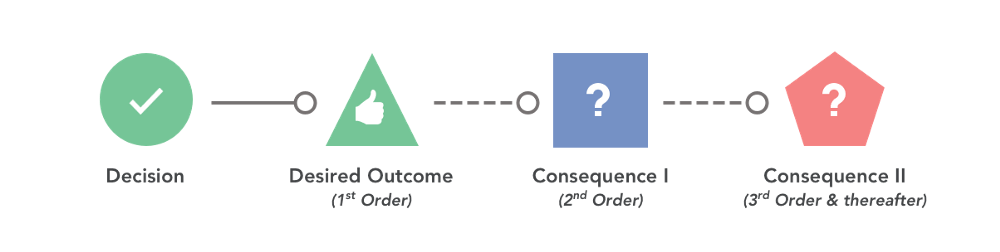
Traditional workflows, for all their rigidity, are at least inspectable. You can trace how a decision was made, step by step.
Agent-driven execution introduces opacity.
An agent may produce the correct outcome, but the reasoning path can be difficult to reconstruct in a way that satisfies audit, compliance, or operational review requirements. As agents chain multiple decisions together across systems, that opacity compounds.
The system works. But understanding why it works — or why it failed — becomes harder.
For regulated industries, this is not a minor issue. It directly affects auditability, compliance, and risk exposure.
The new architecture: systems of execution
What’s emerging is a new layer in enterprise architecture.
Not systems of record. Not systems of engagement.
Systems of execution.
These are agent-driven layers that sit across existing enterprise systems, orchestrating actions dynamically based on context. They don’t replace ERP, CRM, or supply chain systems entirely. They sit above them, deciding how they should be used.
This creates a subtle but important inversion.
Previously, systems defined processes.
Now, agents define how systems are used.
That inversion changes where control resides.
Designing before deploying
The risk is not that agents will fail. The risk is that they will succeed without being properly governed.
Enterprises are moving quickly to deploy agent capabilities because the productivity gains are real. But speed is masking a deeper issue: most organizations are deploying agents before they’ve mapped how decisions flow through their systems.
At 0xMetaLabs, this is where the work starts. Not with model selection or tool integration, but with identifying where decision authority exists, how it is exercised, and what constraints are required when that authority is delegated to autonomous systems.
Because once agents are embedded into core workflows, reversing that delegation is not trivial.
Conclusion
Enterprise software is not just becoming more intelligent.
It is becoming more autonomous.
And autonomy changes everything, not just how systems operate, but how organizations think about control, accountability, and risk.
The companies that treat agents as another feature will integrate them quickly. The ones that recognize them as a new execution layer will design for them properly.
Everyone else will discover the implications after the system has already started making decisions on their behalf.
You May Also Like

SaaS Sprawl and the Expanding Security Surface
Ut enim ad minim veniam, quis nostrud exercitation ullamco laboris nisi ut aliquip ex ea commodo con

Why Modern Brands Are Adopting Composable Commerce
Ut enim ad minim veniam, quis nostrud exercitation ullamco laboris nisi ut aliquip ex ea commodo con

Self-Evolving AI Adoption for Modern Enterprises
Ut enim ad minim veniam, quis nostrud exercitation ullamco laboris nisi ut aliquip ex ea commodo con