


Technical Debt Is Costing You More Than You Think
For most of the last decade, modernization was pitched to executives as a defensive move, a way to reduce maintenance costs, avoid system failures, and keep regulators off your back.
It was the IT department’s problem, spoken in the language of risk registers and budget line items. That framing is now dangerously outdated.
In 2026, technical modernization has become one of the most powerful levers for enterprise growth, and the organizations that still treat it as a cleanup exercise are quietly falling behind competitors who treat it as a strategic weapon. Private equity firms are factoring it into valuations. Boards are demanding it in digital transformation roadmaps. And CEOs are discovering that the question is no longer “Can we afford to modernize?” — it’s “Can we afford not to?”
The Old Story: Modernization as Risk Mitigation
Ask any CIO to pull up their risk register, and technical debt will almost certainly appear somewhere on it. In a landmark survey of 750 C-suite technology executives, only five respondents said that tech debt wasn’t on their risk register, the other 745 indicated it was explicitly listed or embedded under another line item.
The traditional narrative went something like this: legacy systems are fragile, they slow teams down, they create security vulnerabilities, and eventually they’ll break at the worst possible moment. Modernization was the responsible thing to do — a cost of doing business.
What this framing missed is that technical debt isn’t just a risk; it’s an opportunity cost.
Every dollar and every engineering hour spent maintaining an outdated system is a dollar and an hour not spent building the next product, entering a new market, or training an AI model on clean, unified data. The maintenance treadmill doesn’t just drain budgets; it drains competitive momentum.
The Numbers That Changed the Conversation
The shift in how executives think about modernization has been driven, in part, by hard data that reframes the problem from operational to strategic:
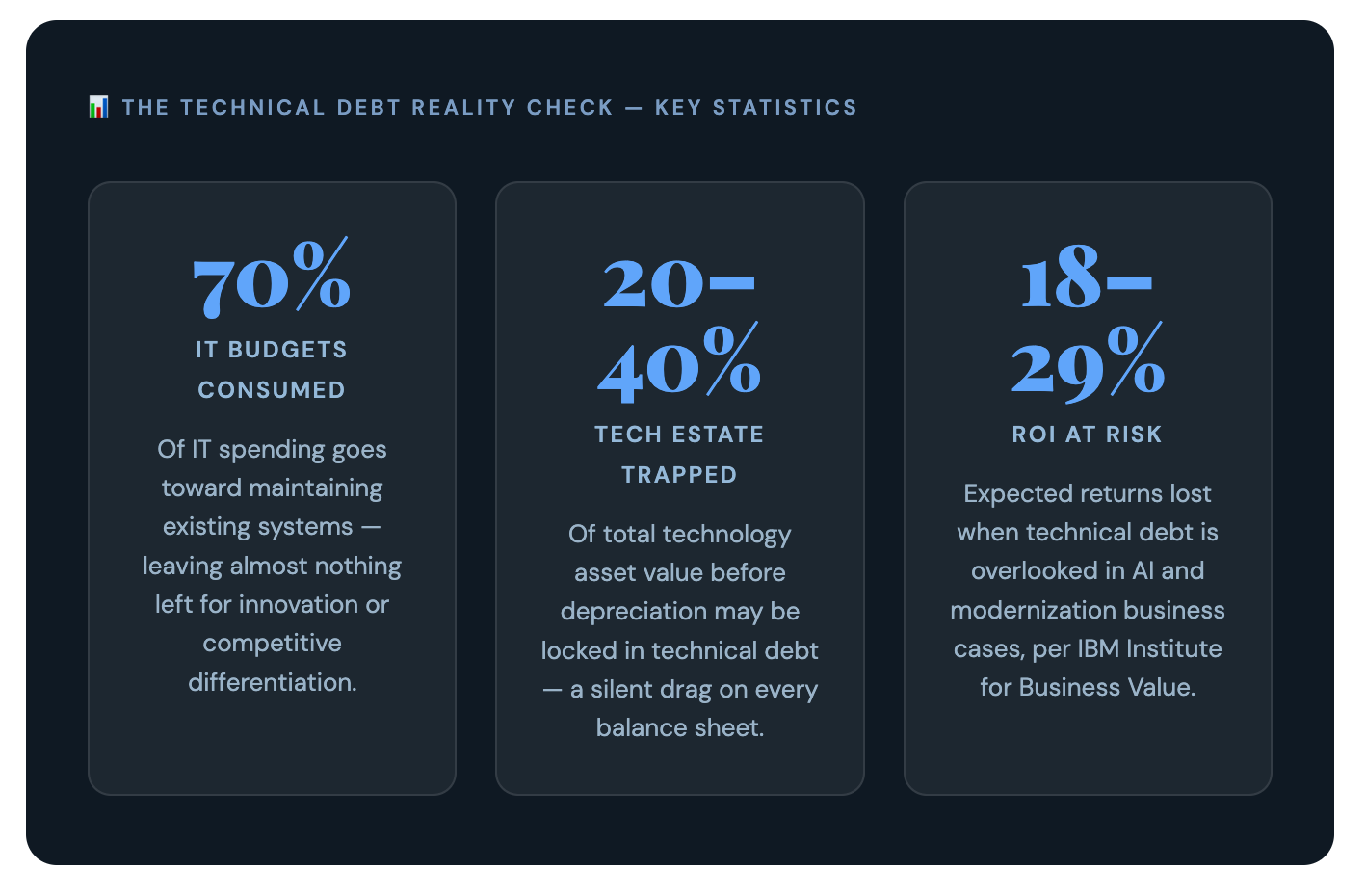
Expected returns are lost when technical debt is overlooked in AI and modernization business cases, per the IBM Institute for Business Value.
Put those numbers together, and a different picture emerges: technical debt isn’t just expensive to fix, it’s even more expensive to ignore.
When Investors Started Caring About Your Tech Stack
Perhaps the clearest signal that modernization has become a growth issue, not just an IT issue, is the way private equity and M&A due diligence has changed.
“During diligence, buyers walk away or slash valuations when they see outdated ERP systems, green-screen supply chain systems, or unsupported databases.”
— RSM US, 2026
This is no longer anecdotal. Across the middle market, dealmakers are building technical maturity assessments into their standard due diligence process. A security breach traced to an outdated system, an AI initiative that stalls because data platforms can’t integrate, or a talent pipeline that dries up because developers refuse to work on legacy stacks, all of these show up in the valuation.
The inverse is equally true: companies that have modernized their platforms command higher multiples, attract better acquirers, and move through exit processes faster. Technical maturity is now a financial signal.
PE-backed companies in particular are feeling this acutely. With compressed timelines to value creation, a portfolio company sitting on years of accumulated technical debt is a liability that directly competes with the thesis that justified the investment.
Five Ways Technical Debt Actively Destroys Growth
Understanding modernization as a growth strategy requires understanding exactly how technical debt suppresses it. The mechanisms are more tangible than most executives realize:

1. It blocks AI adoption.
When systems can’t integrate cleanly, AI initiatives stall at the foundation. Models trained on fragmented, siloed data deliver weak insights and customer-facing AI experiences like personalization and pricing collapse without a unified infrastructure underneath them.
2. It kills agility.
When system updates take 12–18 months, but the market demands results in half that time, you’ve already lost. Legacy applications rarely have the flexibility to support expansion into new product lines, geographies, or business models.
3. It drives away talent.
Developers in the age of AI don’t want to maintain green-screen systems. The best engineers leave, recruiting pipelines weaken, and you end up paying a premium for people willing to work in environments they’d rather leave.
4. It creates M&A risk.
A breach traced to an outdated system, or a failed integration during acquisition, doesn’t just cost money, it damages customer trust and can derail deals entirely.
5. It erodes customer experience.
Legacy back-end limitations manifest visibly: inconsistent pricing, slow response times, and failed personalization. In a digital-first market, your technical debt is visible at every customer touchpoint.
The New Framing: Technical Debt as a Growth Roadmap
Here’s the reframe that forward-thinking organizations are making: technical debt is not a list of problems to fix eventually. It is a roadmap of opportunities to unlock value.
At Digitide, we are seeing organizations shift from treating legacy systems as liabilities to leveraging modernization as a strategic digital advantage, powered by AI-assisted engineering. This means AI doesn’t just write code: it accelerates the understanding of complex legacy systems, compresses months of analysis into weeks, and enables incremental transformation without operational disruption.
The practical implications of this shift are significant:
→ Innovation capacity unlocked. When your engineers aren’t spending 70% of their time on maintenance, they’re building new products. Modernization converts maintenance hours into innovation hours.
→ AI readiness becomes real. A modernized, unified data architecture is the prerequisite for any serious AI initiative. Companies that modernize first move faster on AI second.
→ Speed-to-market improves. Modern cloud-native architectures with CI/CD pipelines and API-first design allow product teams to ship in days, not quarters.
→ Talent acquisition gets easier. Modern stacks attract modern engineers. The compounding effect of better talent on a better platform is enormous over 3–5 year horizons.
What Successful Modernization Actually Looks Like in 2026
The most important lesson from organizations that have modernized successfully is that it doesn’t have to be a big-bang, rip-and-replace program. In fact, the organizations with the best outcomes have almost universally moved away from that model.
McKinsey, Deloitte, and Thoughtworks now converge on a similar pattern: AI can compress modernization timelines and reduce manual toil — but only when orchestrated with strong guardrails and expert oversight. The winning approach is layered:
- Assess before you invest. AI-assisted code analysis tools can right-size the modernization scope before a single engineer starts work. In one documented IBM case, early analysis reduced migration scope by approximately 30% by identifying non-value-adding legacy code.
- Run in parallel, not in sequence. Rather than migrating first and modernizing later, leading organizations combine cloud migration with containerization, API modernization, and security hardening simultaneously. It requires more initial effort but dramatically compresses the overall timeline.
- Treat it as a capability, not a project. The organizations that fall behind are those that treat modernization as a one-time initiative with a completion date. The organizations that pull ahead treat it as an ongoing muscle, a continuous improvement practice embedded in how they operate.
- Connect it to business metrics. Modernization programs that survive leadership changes and budget cycles are the ones tied to measurable business outcomes: revenue per engineer, time-to-market for new features, customer satisfaction scores, and M&A readiness metrics.
The Boardroom Conversation Has Changed
Five years ago, a CIO walking into a board meeting to discuss modernization was there to ask for a budget to fix something broken. Today, the most effective CIOs are walking into those meetings to present modernization as their primary vehicle for growth.
The language has changed, too. Instead of “We need to reduce technical debt,” the conversation is now: “Here is how our technology roadmap enables our next acquisition, our AI product strategy, and our path to a premium valuation.”
Technical debt is an enterprise value problem. It affects your AI readiness, M&A prospects, cyber resilience, and customer trust. Leaders who ignore it will see valuation decline well before systems collapse.
The organizations winning this transition share a common trait: they’ve unified the conversation across the C-suite. It no longer owns modernization; it’s owned jointly by the CIO, CFO, CMO, and CEO, each of whom can articulate what it means for their function and for the business overall.
The Bottom Line
In 2026, modernization is no longer optional, and it is no longer defensive. It is one of the highest-leverage strategic investments an enterprise can make, one that simultaneously enables AI adoption, improves talent retention, reduces operational risk, increases M&A attractiveness, and accelerates time-to-market.
The organizations that recognize this earliest will not just be more efficient, they will be more valuable, more agile, and more competitive in every market they operate in.
The question for every executive team is no longer whether to modernize. It’s whether you’re modernizing fast enough to matter.
You May Also Like

The Rise of Tokenless Web3 in Enterprise Systems
Ut enim ad minim veniam, quis nostrud exercitation ullamco laboris nisi ut aliquip ex ea commodo con
How Hyperautomation is reshaping Business Operations
Ut enim ad minim veniam, quis nostrud exercitation ullamco laboris nisi ut aliquip ex ea commodo con

SaaS Sprawl and the Expanding Security Surface
Ut enim ad minim veniam, quis nostrud exercitation ullamco laboris nisi ut aliquip ex ea commodo con