


Decentralized Identity (DID) for Enterprises: Use Cases Beyond the Hype
If you’ve been watching the identity space for the last few years, you’ve probably seen two waves. The first was grand promises — self-sovereign identity, blockchain IDs, a future without passwords. The second wave is quieter and far more interesting: real pilots and early production uses inside banks, telcos, governments, and large enterprises. This new phase is less about theory and more about solving real problems like KYC, partner onboarding, employee identity, and privacy-preserving authentication.
So what’s actually happening today, and how should businesses approach DID without getting lost in acronyms? Here’s a practical guide — what DID/VCs do, where they help most, the privacy tradeoffs, how to integrate them into current flows, and how to pick vendors and partners.
What is DID (and Verifiable Credentials) — simply
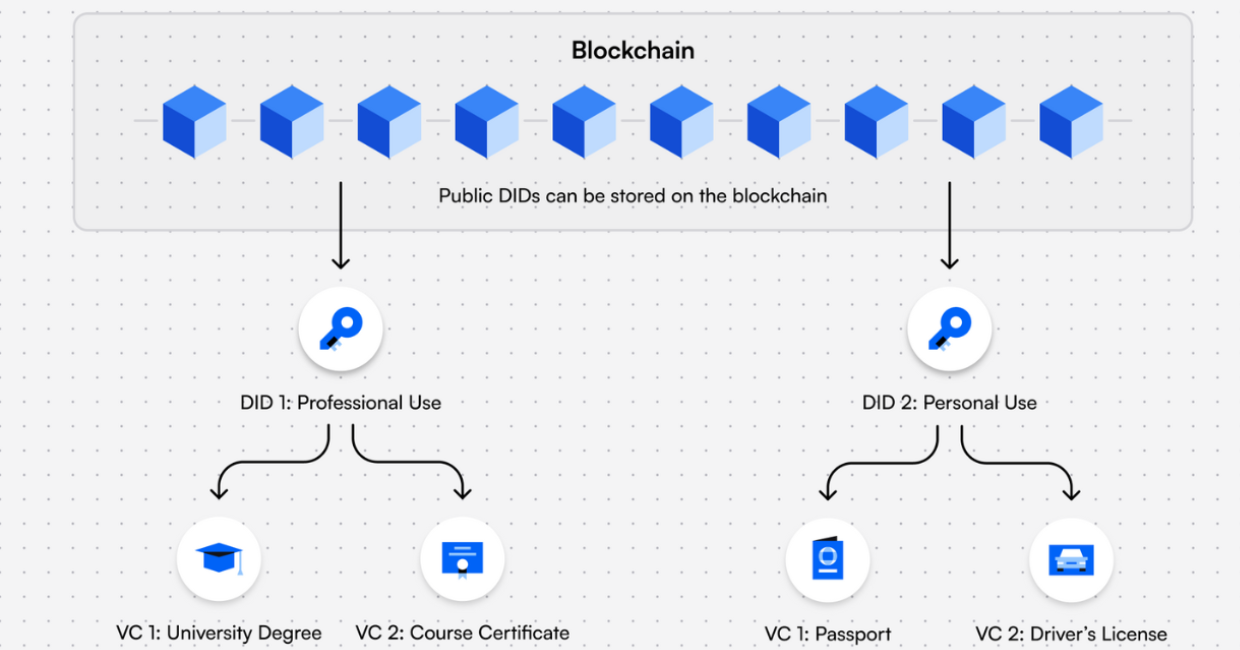
At its core, a Decentralized Identifier (DID) is a new kind of identifier that an entity (person, organization, device) controls independently of a central provider. Verifiable Credentials (VCs) are structured, cryptographically-signed attestations (think “digital credentials”) that can be issued to a DID and presented to verifiers when needed. The W3C standards define how these parts fit together and the broader model issuer, holder, verifier — and that standardization is what’s making adoption realistic for enterprises.
Why that matters: DIDs let you decouple identity from big identity providers (like social logins or central directories). VCs let you carry proofs (for example, “this person passed KYC on 2025–05–12”) that can be cryptographically checked without re-sharing the whole dataset.
Enterprise use cases that are actually moving forward
KYC / Customer Onboarding:
Instead of running the same KYC checks repeatedly, a customer could be issued a reusable, time-bound KYC credential by a trusted issuer (e.g., a regulated onboarding provider). When they open a new account, the bank verifies the credentials rather than repeating the entire data collection and checks. That can cut onboarding friction and recurring verification costs substantially, especially for customers who use multiple financial services. Early enterprise pilots show measurable reductions in time and cost for onboarding workflows.
Partner & Vendor Onboarding:
Large companies constantly onboard suppliers and partners with expensive paperwork, attestations, and audits. VCs let partners present standard attestations (company registry proof, compliance certifications, supplier checks) that are reusable and auditable by multiple verifiers.
Employee & Contractor Identity:
Enterprises can issue employee credentials for building access, internal systems, and secure collaborations. These credentials can be scoped temporarily (contractors) and revoked instantly without creating new accounts in every system.
Privacy-Preserving Checks:
Verifiable credentials can support selective disclosure, letting a holder prove a claim without revealing underlying data (for example, “age ≥ 18” rather than the full birthdate). Research and practical tools for selective disclosure are maturing, and this is a core reason enterprises are experimenting with DID-based flows.
Cross-Border & Regulatory Use:
For cross-border services (payments, health records), verifiable credentials provide an auditable, interoperable way to exchange identity claims without shipping personal data across borders in raw form. Recent cross-border pilots and research reports highlight this potential for payments and regulated industries.

The privacy tradeoffs: what DID improves and what it doesn’t
Decentralized identity reduces centralized data collection and creates reusable attestations, which is a privacy win. But it’s not magic. If implementations are careless, they can leak linkable identifiers or over-share: a poorly designed flow can allow multiple verifiers to correlate a holder’s presentations and reconstruct identities.
Selective disclosure and predicate proofs (including zero-knowledge styles) address this: holders reveal only the attributes required, and the verifier checks cryptographic validity without seeing the raw source. Those capabilities are getting more practical — but they require careful engineering and policy choices (which credentials are revocable, which attributes are allowable for a particular use case, how long to store metadata, etc.). Academic and industry reviews are actively comparing selective disclosure methods and their tradeoffs.
How DIDs and VCs actually plug into existing flows
Start with a target flow — for example, “new business customer KYC for our lending product.” Map who currently issues data (third-party KYC providers, government registries), who needs the data, and where it’s stored. The DID/VC approach replaces repetitive checks with a model where trusted issuers create credentials and holders store them in wallets. Verifiers request proof, and the holder presents a minimal, verifiable response.
There are three practical integration patterns you’ll see in enterprise pilots:
- Proxy verification — verify a VC via an intermediary API gateway that abstracts the cryptographic checks from legacy systems. This is low-friction for existing apps.
- Native verifier integration — embed VC verification into the app stack; the app speaks DID/VC protocols directly and enforces policies.
- Hybrid: verification + audit trail — verify credentials but also log (in privacy-preserving ways) metadata for compliance and audit.
All three are legitimate picks based on how fast you need to move and how coupled your legacy systems are.
Implementation essentials (a practical checklist)
Adopt the standards first: implement DIDs and VCs conformant with W3C recommendations so your credentials remain interoperable. Use DID methods and ledger/registry choices that match your governance model — public DLT-based DID methods (e.g., ION) work for some scenarios, while permissioned ledgers or registry services suit others.
Think about wallets. Enterprise identity flows commonly use mobile or cloud wallets for holders; enterprises sometimes provision managed wallets for employees or partners, and let customers use self-hosted wallets. Decide in advance whether the wallet is user-managed or enterprise-managed.
Design for revocation and lifecycle. Issuers need efficient revocation checks. Approaches vary (revocation registries, cryptographic accumulators). Decide how immediate revocations must be, and pick technology accordingly.
Plan for selective disclosure and privacy. If your use cases require revealing attributes without raw data, adopt credentials that support presentation proofs or ZK-based predicates. Test the UX: users must understand what they share and why.
Make governance explicit. Define who can issue which credentials, audit trails, and compliance pathways. Pilot with a narrow scope, instrument usage, and then expand.
Vendors and platforms — a pragmatic comparison
The ecosystem has matured: Microsoft (Entra Verified ID), Hyperledger frameworks, Evernym/Trinsic, and other vendors offer enterprise-ready stacks. They vary in focus: some aim for tight M365 integration and admin UX (Microsoft Entra), others emphasize open standards and interoperability (Hyperledger Aries/Indy and Aries agents), and others focus on developer experience and hosted services.
A few pragmatic notes. If you’re heavily on the Microsoft stack and need fast internal adoption, Entra Verified ID can be a low-friction route. If you need ledger-agnostic, open-source tooling geared for cross-organization portability, Aries/Indy ecosystems and vendors built on them often fit better. Reviews and head-to-head comparisons highlight tradeoffs between ease of use, governance flexibility, and openness; pick the one that matches your enterprise constraints and integration surface.
Common pitfalls we’ve seen in pilots
Teams often underestimate the operational pieces: wallet support, key recovery and rotation, revocation responsiveness, and the compliance audit trail. Another trap is assuming “blockchain = DID.” Many DID methods only use ledgers for discovery (DID documents) while the actual credential exchange is off-chain. That nuance matters for performance and privacy.
Finally, neglecting UX kills adoption. If holders find the wallet experience confusing or verifiers get cryptic errors, the rollout stalls. Pilot with real users and operational teams, not just developers.
Is it worth it? (cost and ROI signals)
Early pilots show promising ROI in specific verticals: repeated KYC across services, supplier onboarding, and employee credentialing show the quickest wins because they reduce duplicated verification work and audit costs. Market forecasts suggest rapid growth in DID adoption and enterprise tooling, driven by KYC efficiencies and regulatory interest. This is not just niche academic interest anymore.
How 0xMetaLabs helps enterprises move from PoC to production
We treat DID adoption as both an engineering and a change-management challenge. Our practical approach typically starts with a two-week assessment: map identity flows, quantify repeated verification costs, and identify the minimum viable credential set (e.g., KYC attestations, corporate supplier proof, employee access tokens).
From there, we help:
- design issuer/verifier trust frameworks and governance;
- select DID methods and vendor stacks that match compliance and integration needs;
- build wallet strategies (managed vs BYO) and key recovery policies;
- implement revocation, audit logging, and privacy-preserving proofs;
- Run staged pilots with measured KPIs — onboarding time, verification cost, and support ticket reduction.
We focus on making DIDs practical: reducing friction for holders, keeping verifiers secure and auditable, and ensuring the architecture plugs into existing IAM/PAM and onboarding systems — not replacing them overnight.
Final thought
DID and verifiable credentials aren’t a silver bullet, but they’re no longer a shiny theoretical experiment. Standards have matured, enterprise pilots are proving value in KYC and supplier onboarding, and privacy-preserving techniques like selective disclosure are nearing production readiness. The sensible path is to start narrow, measure, and expand — while keeping governance, UX and revocation mechanics front-and-center.
If you want, I can turn this into a one-page checklist you can hand to your identity team, or build a short vendor-comparison matrix based on your tech stack (Azure, AWS, internal PKI, compliance needs). Which would be more useful right now?
You May Also Like

How Automation Debt Turns Scripts Into Outage Risks
Ut enim ad minim veniam, quis nostrud exercitation ullamco laboris nisi ut aliquip ex ea commodo con

Why Businesses Need Infrastructure Resilience Strategies
Ut enim ad minim veniam, quis nostrud exercitation ullamco laboris nisi ut aliquip ex ea commodo con

Self-Evolving AI: What It Means for Businesses
Ut enim ad minim veniam, quis nostrud exercitation ullamco laboris nisi ut aliquip ex ea commodo con